May
13
I am hopeful that my photographs strike an emotional chord thereby enabling the viewer, if just for a moment, to step out of his or her limited sense of self. I was reminded of this phenomenon this past weekend.
A friend and I have just returned from our annual pilgrimage to the Bach festival in Bethlehem, PA. Discussing the generally recognized sacred nature of Bach’s music and our own individual thoughts and experiences in listening to the live performances, the following idea arose:
Just as a cello is made up of strings, a box of wood, and the air in the box (among other components) and these components taken together, when played by the Cellist, create sound that has an effect on the environment, and the cello is but a component of the orchestra, and the orchestra is but a component of the orchestra-choir collaboration, we too, as listeners, whose emotional chords are plucked ever so effectively by the music, begin to vibrate. It occurs to me that I am not big enough an observer to see that the vibration of my own emotion, like the vibration of the strings on a cello, like the sound emanating from the living, breathing orchestra (watching the players as they respond to the conductor, it seems that they rise and fall as one like the heartbeat of a living being), is nothing more than a component in the performance.
The conductor moves his baton, the strings of the cello vibrate with the bow, the strings of the harpsichord vibrate when plucked, the vocal cords of the choir members and soloists vibrate, all sending a wave of sound into the air (and how wonderful it was to be sitting in the air that was disturbed by the single note of the harpsichord and to realize that classical music, like jazz, can be like a desert to me when played on the radio, but a lush garden when experienced in live performance). The wave of sound overtakes me and I have an emotional response in one moment, and in another moment I am impelled to close my eyes and find myself in a state of mind I associate with the practice of Transcendental Meditation.
Both my friend and I had strong emotional reactions to various of the pieces performed. If the “vibration” of our emotions (not a physical vibration, but something I am not big enough to see because it is an effect beyond the realm of my sensory mechanism) can be viewed as similar to the vibration of the strings on the cello or the vibration of the vocal cords of the vocalists, might not my participation in listening to the music be nothing more than a component in the performance when viewed from an expanded perspective.
If indeed there is a “vibration” of emotion, then, like the sound of the cello contributing to the performance, by virtue of living and responding to this beautiful music I am nothing more than a component of the musical performance. With this perspective, I can imagine that every phenomenon is nothing more than a component in a sacred orchestral piece. Is it possible, informed by this point of view, that at the moment I put my attention on Bach’s “Mass in B Minor”, for example, that piece can be viewed as the music that overtakes the universe (cello contributes to orchestral music contributes to orchestral-choir collaboration contributes to my emotional response contributes to how I interact with the world contributes to how the world exists (at least for me))? And if this is possible, might not the same be said of any other successful work of art, or indeed any other point of focus?
Apr
16
Magda Indigo publishes a photoblog. In a recent post which she calls Passion Indeed! Magda decries the lack of care people seem to give when posting images on the internet.
In looking through a friend’s Flickr gallery of photos from a recent family wedding, I was overwhelmed by the sheer volume of images, some of which had the faces of the subjects severely underexposed because the camera metered on the background light. Why, I wonder, were those pictures included in the gallery? I understand that many people simply dump the contents of the memory card from their camera onto the website; however, I am less likely to find the pictures that photographer really wants me to see if I have to slog through tens or even hundreds of mediocre images to separate the wheat from the chaff. I soon tire of the chore and might never see the “keeper” images.
I have also seen edited photo galleries where someone will post two versions of the same shot. Maybe one is cropped a little bit more, or one is black and white and the other color. I become confused: what is this photographer’s vision? Which image best conveys your sense of the subject? By seeing both versions, I don’t know which is the best effort and which the throwaway, and that steals the thunder from both of them.
One commentator to Magda Indigo’s blog post suggests that there should be a web site where people post only their greatest images. In my view, your audience would be well served if you treated whichever website you use to share your photos as just such a forum, one in which you post only those images that you feel to be among your best photos.
You may read Magda Indigo’s thoughts on this subject by clicking -HERE-.
Mar
11
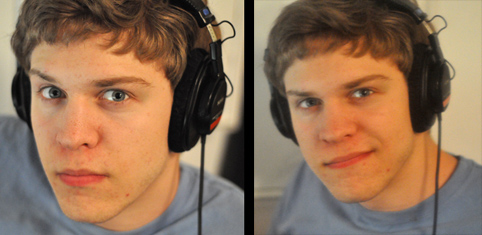
There is a photograph of Jack Nicholson on the cover of the March/April 2008 AARP magazine. I am struck by the photographer’s use of depth of field. In the photo, the main part of Nicholson’s face is in focus while his left ear, the top of his head, and his shoulders are out of focus. I looked inside the front cover for the photo credit and discovered it was shot by Sam Jones.
I wanted to see more of Sam Jones’ work so I did a Google search on his name. I don’t know if it is the same Sam Jones (see the reader’s comment below), but I came across the website of a certain Sam Jones and looked at her work. I was struck by the way she does her head shots.
If you log onto Sam Jones’ website by clicking –HERE– and look at the bottom row of photographs, you will see three head shots. The second photo in the row is a color portrait of a woman, and Jones has included her entire head in the photograph. The last two images in the row, on the other hand, are head shots in which the top part of the subject’s head is cut off by the frame.
I have seen other photographers make similar compositions and I generally find such pictures disturbing.

-
-
-
-
-
-
-
-
-
Not to be dogmatic, however, in the photograph I call “Deep Thinker”, reproduced above, the subject’s whole face is not shown. In that instance, it was not possible for me to include the whole face, because “Deep Thinker” is a photograph of a child peering out from the small round window in a concrete castle on a playground, and in any event, I think this photo is successful with the close focus on the subject’s face.
In my view, with a traditional straight-on head shot, a composition I generally find dull in any event, to cut off the top of the subject’s head robs the image of closure.
To see my other portraits, click –HERE–
_________________
Jeff Gatesman comments:
“Interesting dichotomy, using an image you shot with the head cut off at the top to illustrate how you don’t like that form of cropping. You explain why you cropped the child so close when, in fact, I think it is very powerful the way it is, without explanation. The emotion of this photo is all in the eyes and a little in the mouth; there seems to be no reason to include all of his head. The highlights of his face surrounded by the dark edges creates a moody kind of power. There is also a shallow depth of field here that I like.”
You may view Jeff’s photographs by visiting his website www.gatesman.com
________________
Another reader comments:
“The Sam Jones you’re interested in is at www.samjonespictures.com. He recently released a photo monograph “the here and now”. I am a wilco fan, and he shot and directed the wilco documentary from a few years ago — that’s how I got into his work!“
Mar
10

At an impromptu jam session, someone handed me a sketchpad and invited me to draw. I replied, “I sketch with my camera.”
The resulting image, Pete Plays the Blues, will be exhibited at the Laurel Art Guild’s 39th Annual Open Juried Exhibition at the Montpelier Arts Center in Laurel, Maryland, March 9 through March 30, 2008.
This image was created in camera on 35mm black and white film.
Feb
21
Readers now may subscribe to receive new articles by email. The articles will be sent in plain text format. You may sign up by entering your email address in the subscription box at the top of the column at the left.